

A Complete Guide to Building a Funnel That Attracts, Converts, and Retains Owner Clients
The property management industry is more competitive than ever. Whether you're managing 50 doors or scaling toward 1,000, the challenge remains the same: how do you consistently attract high-quality property owners and convert them into long-term clients?
This guide is designed to walk you through a proven property management marketing strategy — from the first click to the signed contract and beyond. We’ll break down the marketing funnel, match each stage with best-in-class tools and tactics (including PMW services), and share key performance indicators (KPIs) and budget tips to keep you focused and growing.
What Is a Marketing Funnel?
Think of the marketing funnel as the path your future clients follow before choosing your company. Each stage represents their mindset, questions, and needs at that time.
A marketing funnel illustrates the journey a customer takes from first discovering your brand to becoming a paying client. HubSpot defines it here as a model that organizes that process into distinct, strategic stages.
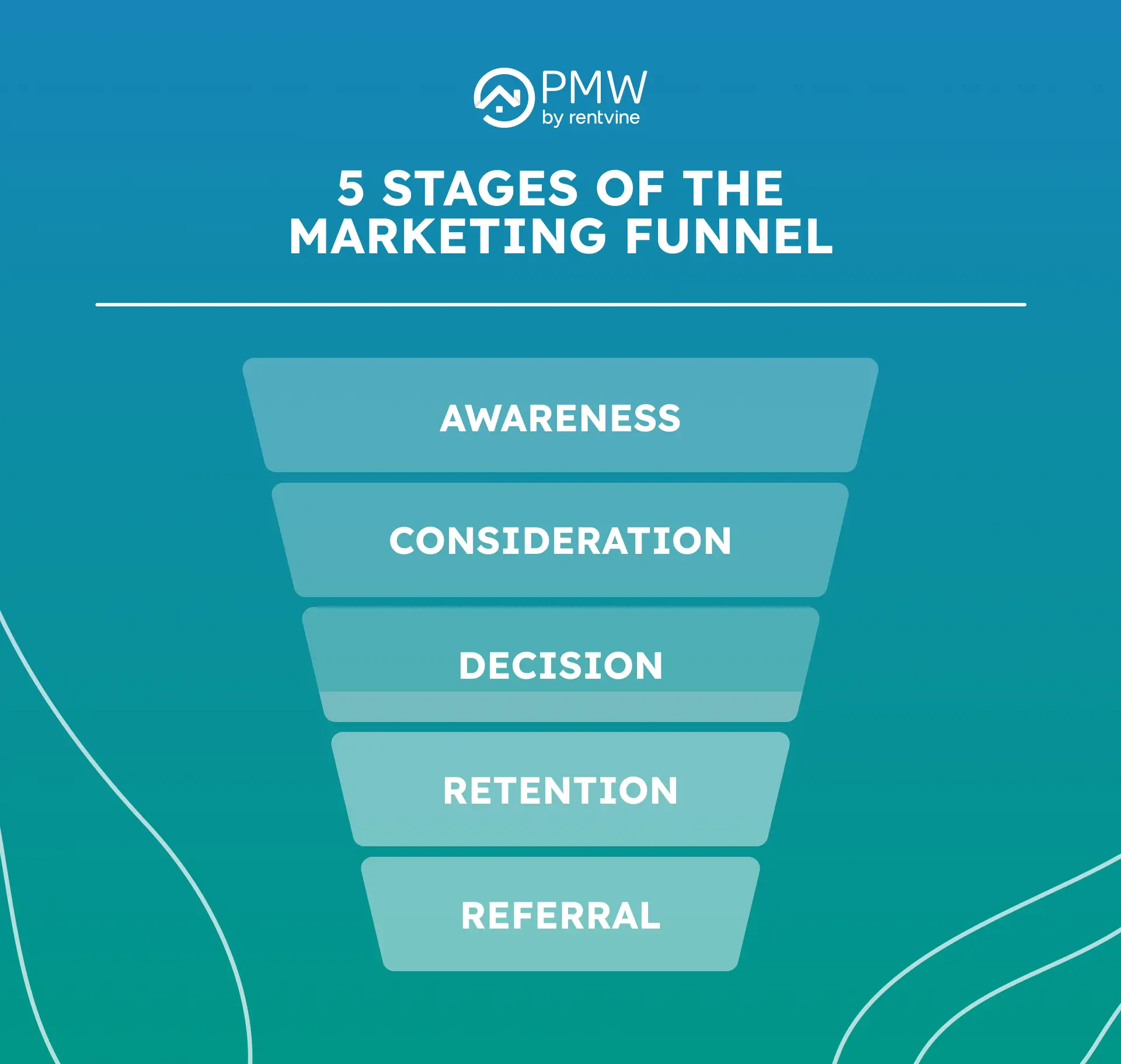
The five key stages of the funnel are:
Awareness
Consideration
Decision
Retention
Referral
Let’s explore each stage and what strategies you should be using.
Stage 1: Awareness
Goal: Make property owners aware that your business exists.
At this stage, prospects are either searching for help, researching the rental process, or don’t even realize yet that they need a property manager. Understanding how Google ranks content is key to building visibility. Google’s own guide on how search works offers insight into the algorithm’s focus on relevance, usability, and authority.
Effective Strategies:
Search Engine Optimization (SEO)
Create optimized service pages, market landing pages, and helpful blog content.
Use keyword-rich, high-quality content that answers early-stage questions like:
“How to rent out a house without a realtor”
“What does a property manager do?”
Google Ads & Microsoft Ads (PPC)
Capture high-intent searchers looking for your services.
Appear above competitors on Google when it matters most.
Educational Video Content
Introduce your brand with short-form video across YouTube or Facebook.
Topics like “What to Expect from a Property Manager” work well.
Social Media
Build local awareness with market-specific posts on Facebook, LinkedIn, or Instagram.
KPIs to Track:
Impressions (Ad and Organic)
Clicks & Click-Through Rate (CTR)
Branded search volume growth
New users to website
Budget Tip:
New PMs often allocate 40-60% of initial spend to awareness, especially if starting with low visibility. Prioritize SEO + targeted paid ads to build traction.
Stage 2: Consideration
Goal: Nurture leads as they compare providers.
Now that an owner is aware of your company, they’re weighing their options. You need to provide reassurance and clarity.
Effective Strategies:
High-Converting Website
Your website must load fast, look professional, and drive action.
Include easy navigation, trust badges, service area maps, reviews, and contact CTAs.
Automated Rental Analysis Tools
Offer free rental analysis (via PMW AMP) to encourage owners to submit property details.
PMW AMP has shown sub-$10 CPL results for clients.
Video Walkthroughs & Explainer Content
Videos boost time on site and conversion rates.
Online Reviews & Reputation Management
Use a review funnel to collect 4–5 star ratings on Google and Facebook.
Joining organizations like NARPM can also boost your credibility with owners and referral partners looking for a vetted, professional property manager.
Remarketing Ads
Show ads to people who visited your website but didn’t convert.
KPIs to Track:
Rental analysis submissions
Bounce rate
Session duration
Website conversion rate (form fills, calls)
Budget Tip:
Budget 20-30% toward tools and tactics that drive conversions (website, rental tools, review automation).
Stage 3: Decision
Goal: Convert warm leads into signed management agreements.
At this stage, the owner is actively choosing a property manager. This is where your credibility and process must shine.
Effective Strategies:
Dedicated Landing Pages for Ads
Lead Tracking and Follow-Up Automation
Transparent Pricing Pages
Custom Sales Videos
Case Studies or Local Testimonials
KPIs to Track:
Call tracking leads (listen to recordings!)
Demo requests / consultations booked
Sales-qualified leads (SQLs)
Close rate (click-to-contract)
Budget Tip:
Expect to spend $3,000–$5,000 one-time for a high-converting website and $145–$300/mo for hosting, AMP, and support.
Stage 4: Retention
Goal: Keep property owners happy long-term.
The true value of a client is in the years they stay with you. That makes retention one of the highest ROI strategies.
Effective Strategies:
Client Onboarding Email Sequences
Monthly Owner Reports or Dashboards
Email Campaigns with Tips and Market Updates
Video Check-Ins
KPIs to Track:
Churn rate
Net promoter score (NPS)
Email open & click rates
Average client lifespan
Budget Tip:
Retention costs less than acquisition. Use email, video, and personal touchpoints.
Stage 5: Referral
Goal: Turn satisfied clients into brand advocates.
Effective Strategies:
Review Requests After Key Milestones
Referral Program
Testimonials & Case Studies
LinkedIn Networking & Engagement
KPIs to Track:
Referrals received
Reviews generated
Review rating (4.7+ is ideal)
Social shares
Budget Tip:
Referral marketing often delivers the best leads at the lowest cost.
FAQs: Property Management Marketing Strategy
1. What is the most important part of a property management marketing strategy? The most important part is a cohesive funnel — not just generating traffic, but converting it into leads and contracts with a high-performing website, clear CTAs, and follow-up systems.
2. How much should a new property management company spend on marketing? New PMs often spend 5–10% of monthly revenue on marketing. For faster growth, $1,500–$3,000/month can deliver strong results in competitive markets when allocated properly across SEO, PPC, and tools like PMW’s AMP.
3. What’s the fastest way to get new property management clients? Paid search (PPC) is the fastest channel, showing results within days. Combine it with a strong website and rental analysis tool for best results.
4. How long does SEO take to work for property managers? SEO is a long-term strategy. You may see traction in 3–6 months, with major growth compounding after 12+ months when paired with local landing pages and consistent content.
5. What tools should I use to track property management leads? Use call tracking, form tracking, and CRM integrations (like LeadSimple) to track where leads come from and how they convert.
6. Why should I choose PMW for my marketing? PMW is the most specialized agency in the property management industry, combining SEO, PPC, high-performance websites, rental tools, and integration support all under one roof.
Final Thoughts: Marketing That Grows With You
Whether you’re just getting started or pushing toward your next 100 doors, remember this:
Each funnel stage builds on the last.
Your website, SEO, and ads must work together.
Conversion and retention are just as important as awareness.
Don’t settle for disconnected tools or generic agencies. Choose a partner who understands the investor mindset and the property management business.
At PMW, we’re the hardest-working marketing agency in the space. We’ve helped clients scale from 300 to over 6,000 doors with:
SEO that drives traffic
Websites that convert
Paid search that generates leads
Tools that follow through
Ready to Grow?
Let’s turn your marketing into a predictable, profitable growth engine.